

Driving sustainable manufacturing through automation

Sustainability is no longer a mere option in today’s manufacturing industry—it’s a necessity. As global standards and consumer expectations evolve, manufacturers face growing pressure to operate more efficiently, responsibly, and transparently. Automation has emerged as a key driver of this transformation, empowering manufacturers to streamline processes, minimize waste, and conserve vital resources.
With the rise of Industry 4.0, advanced technologies such as smart sensors, AI-powered analytics, and digital platforms are ushering in a new era of sustainable manufacturing. In this blog, we explore how automation and digital innovation are shaping the future of manufacturing—enabling companies to enhance efficiency, improve product quality, and support both environmental and social responsibility.
Table of Contents
- Role of automation in Environmental, Social, and Corporate Governance (ESG)
- Minimizing waste through precision automation
- Enhancing efficiency and productivity with automation
- Harnessing data analytics for smarter manufacturing
- Other sustainable manufacturing practices enabled by automation
- Smart industries and the future of sustainable manufacturing
- Bring sustainability to your operations with Premier Tech
Role of automation in Environmental, Social, and Corporate Governance (ESG)
Automation plays a pivotal role in supporting ESG initiatives within the manufacturing sector. By optimizing resource use and minimizing waste, automated systems significantly reduce the ecological footprint of manufacturing.
The integration of automation technologies promotes sustainable practices such as recycling and waste reduction, ensuring efficient material processing and minimizing landfill contributions. Moreover, automation enhances workplace safety by taking over dangerous and repetitive tasks, reducing the risk of accidents and injuries, and improving overall job satisfaction. By adopting sustainable automation practices, companies can positively impact their communities and demonstrate strong corporate governance.
Minimizing waste through precision automation
Better control for less waste
Automation is essential for reducing waste by providing precise control over production processes. This accuracy minimizes material loss and defects, benefiting both the environment and the bottom line. For example, Premier Tech’s SpeedAC iQ uses state-of-the-art, microprocessor-controlled technology to deliver extremely precise bag weights for bulk materials, helping reduce product giveaway and material loss.
In sectors like food and chemicals, preventing contamination is critical. For such applications, machines such as Premier Tech’s VPF Series are highly suitable, enabling human-free product handling. This ensures pristine product purity, better control against leaks and dust emissions, and helps ensure nothing escapes from the factory. As a result, less product is lost due to quality issues, leading to higher yields and reduced waste. The VPF Series offers exceptional speed and high-precision operation, with filling accuracy as tight as ±1 oz for 95% of fills, making it ideal for the strict demands of the food and chemical industries.
CHRONOS VPF SERIES
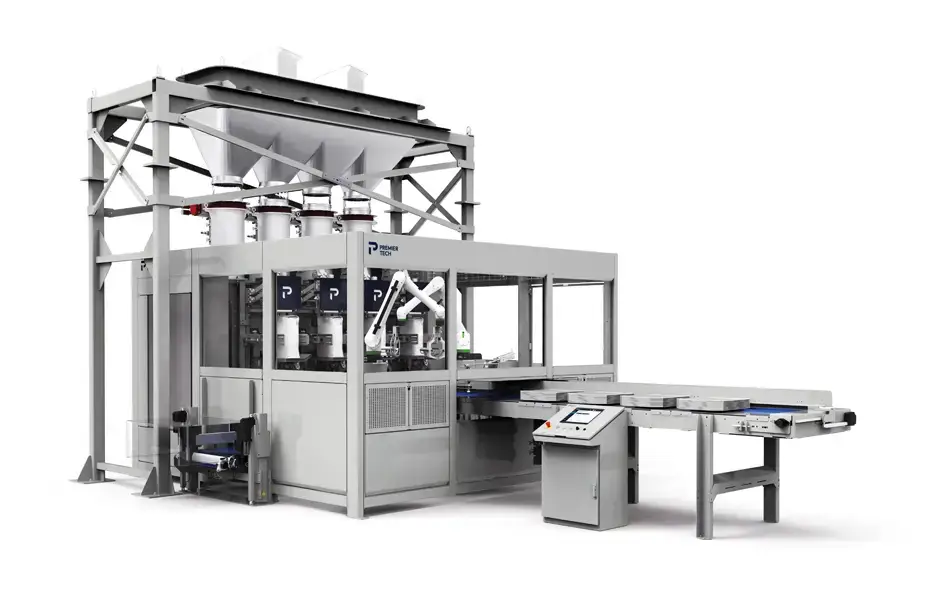
- High filling accuracy: ±1 oz @ 2 sigma
- Ultrasonic sealer: seals bags at the spout, preventing leakage and ensuring product integrity
- Precise weight control: reduces product waste and saves costs
- Dust control: for clean filling and minimal product loss
Other automation tools, such as inventory control software, AI-powered analytics, and computer vision, help companies optimize inventory management, prevent overproduction, and further reduce excess waste. According to the FAO, if we could reduce food waste and loss by just 25 percent, it would provide enough additional food to feed about 500 million people each year. This is significant, especially considering that by 2050, we will need to produce 60 percent more food to feed a projected global population of 9.3 billion.
Reducing inventory and waste with on-demand automation
Automation enables manufacturers to shift to on-demand production, minimizing inventory requirements, reducing warehouse space, and significantly lowering the risk of product waste due to deterioration or obsolescence.
Additionally, automation increases warehouse and order fulfillment efficiency. Robots can pick and pack orders, reducing the time and energy required for these operations.

Enhancing efficiency and productivity with automation
Automated systems—including conventional and robotic palletizers, open-mouth baggers, and other machinery—can operate continuously without breaks, significantly increasing throughput. By minimizing human error and standardizing operations, automation leads to greater productivity and consistently high product quality.
One major advantage of automation is its ability to quickly adapt to changing production demands while maintaining precise control at every stage. This consistency boosts product quality and reduces defects and rework, saving both time and costs.
Automation is also transforming energy use in manufacturing. Advanced technologies such as smart sensors, machine learning, and AI-powered analytics help optimize processes and lower energy consumption, resulting in leaner and more cost-effective operations.
Rising electricity demand and the role of automation
Global electricity demand is projected to increase significantly in the coming years, which is likely to put upward pressure on energy prices and increase volatility in the market (International Energy Agency). In this context, automation becomes a key strategy for manufacturers, enabling them to optimize energy consumption, manage operational costs, and build resilience against market fluctuations. Energy-efficient automation solutions, real-time data monitoring, and smart scheduling can help companies reduce their energy footprint and remain competitive even as electricity prices rise.

Harnessing data analytics for smarter manufacturing
Integrating data analytics into automation allows manufacturers to make informed decisions based on real-time data. Smart industries leverage IoT devices and analytics to monitor and optimize every aspect of production, from energy usage to equipment performance. This data-driven approach not only enhances efficiency but also supports continuous sustainability improvements.
For example, predictive maintenance powered by AI can anticipate equipment failures, minimizing downtime and reducing energy waste. Solutions like Necton™ by Premier Tech enable proactive maintenance, cutting downtime by up to 50% and lowering maintenance costs by 30–40%. By addressing issues early, Necton™ extends equipment lifespan and helps manufacturers operate more sustainably.
Other sustainable manufacturing practices enabled by automation
Improved traceability
Consumers are increasingly concerned about the origins of the products they purchase. Automated systems enable companies to maintain full traceability, tracking raw materials from their source to the final product. This transparency helps businesses monitor compliance with environmental and labor standards, promoting ethical practices throughout the supply chain.
Creating more valued jobs
Automation will also have a positive social impact by upskilling team members and enabling the creation of new roles. Rather than simply creating or eliminating jobs, automation transforms existing positions—allowing team members to take on more meaningful and sustainable work (International Society of Automation).
At Premier Tech, we’ve seen how automation can help our clients create better work environments for their team members, providing safer workplaces and reducing the number of physically demanding and repetitive tasks. This leads to lower turnover rates, which is especially valuable as manufacturers face increasing challenges in attracting and retaining labor.
Beyond safety and job enrichment, successful automation projects often involve team members from the very beginning—through training programs, open communication, and opportunities to contribute ideas for process improvement. At Premier Tech, we support our clients by providing training and guidance to their team members throughout the automation process. This inclusive approach fosters a culture of innovation and engagement, ensuring that automation benefits both the company and its people.
Smart industries and the future of sustainable manufacturing
The concept of smart industries or Industry 4.0 is transforming traditional manufacturing into a more connected and intelligent ecosystem. Smart industries leverage IoT, AI, and cloud computing to create highly efficient, adaptive, and sustainable manufacturing processes.
This digital transformation enables manufacturers to respond quickly to changing market demands and environmental regulations, ensuring long-term sustainability.
By adopting automation, manufacturers can optimize energy use, reduce waste, enhance productivity, and promote green manufacturing practices. The future of manufacturing lies in smart, sustainable, and efficient operations driven by advanced automation technologies.
Looking ahead: Industry 5.0 and sustainable manufacturing
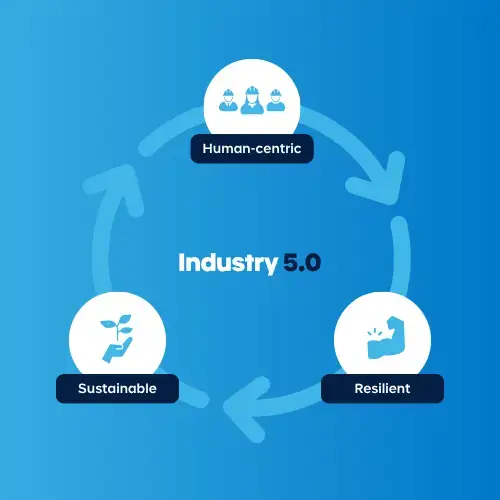
While Industry 4.0 is still being adopted by many manufacturers—laying the foundations for smart, automated production—Industry 5.0 is emerging as the next evolution on the horizon. According to the European Commission, Industry 5.0 “provides a vision of industry that aims beyond efficiency and productivity as the sole goals, and reinforces the role and the contribution of industry to society.” This future-oriented approach places even greater emphasis on sustainability, human-centric innovation, and resilience.
- Sustainability: Industry 5.0 focuses on reducing environmental impact through efficient resource use, waste minimization, and the adoption of green technologies. By integrating automation with responsible practices, manufacturers can move towards more sustainable and low-emission operations.
- Human-centric innovation: A core pillar of Industry 5.0 is putting people at the center of industrial transformation. This means valuing the expertise, creativity, and well-being of team members by promoting closer collaboration with advanced technologies like collaborative robots (cobots). The goal is to empower teams to focus on meaningful tasks, improve safety, and foster a more engaging workplace.
- Resilience: Industry 5.0 emphasizes building manufacturing systems that are adaptive and robust in the face of disruption. By making operations more agile—with advanced analytics, flexible automation, and digital connectivity—companies can better withstand shocks such as supply chain interruptions or rapidly changing market demands, ensuring business continuity and long-term success.
Solutions like TOMA™, Premier Tech’s collaborative robot cell, embody these Industry 5.0 pillars by enabling safe collaboration, supporting sustainability initiatives, and increasing flexibility and resilience in manufacturing.
Bring sustainability to your operations with Premier Tech
As the manufacturing landscape continues to evolve, automation has become a cornerstone for building a more sustainable, efficient, and resilient industry. By embracing advanced automation technologies, manufacturers can significantly reduce waste, optimize energy usage, and create safer, more meaningful work for their team members. The integration of data analytics, smart systems, and innovative solutions like predictive maintenance not only drives operational excellence but also supports broader environmental and social goals.
At Premier Tech, we are committed to helping our clients harness the full potential of automation to meet their sustainability objectives. Through Premier Tech Digital’s Industry 4.0 Professional Services, we work alongside manufacturers to design and implement customized digital strategies—empowering them to unlock new efficiencies, improve traceability, and transform their operations for a more sustainable future.
Together, we can shape a manufacturing industry that is not only productive, but also environmentally responsible and future-ready.
Ready to take your manufacturing to the next level?
Discover how Premier Tech’s automation solutions can boost your productivity and sustainability.
