Go back to all articles

Why spare parts management matters more than ever in manufacturing

Premier Tech parts specialist searching for a component in the spare parts storage room

In manufacturing, spare parts are often seen as a backup resource, something to use only when a component fails. In reality, they play a much bigger role in keeping operations running efficiently. When the right part is not available at the right time, the result can be longer downtime, higher costs, and greater pressure on maintenance teams. As manufacturers look for ways to improve uptime and control costs, spare parts management is becoming a more strategic priority, especially when supported by preventive maintenance and digital tools. 


In this article, we’ll explore: 

  1. Introduction: the link between spare parts and manufacturing uptime 
  2. The hidden costs of poor spare parts management 
  3. Best practices for managing spare parts efficiently 
  4. How preventive maintenance improves spare parts planning 
  5. How digital tools are changing spare parts management
  6. Conclusion: a smarter approach to uptime, maintenance, and cost control

Introduction: spare parts, uptime, and operational resilience 

In manufacturing, spare parts are often seen as a support function, something kept on hand in case a component fails. In reality, they play a much bigger role in day to day performance. The availability of the right part at the right time can make the difference between a quick repair and a prolonged production stoppage. 

Why spare parts matter more than ever

As downtime costs continue to rise across industries, spare parts management has become more strategic than ever. According to Siemens, nearly every major sector surveyed experienced per-hour downtime costs in 2022 or 2023 that were at least three times higher than in 2019. In the CPG sector, annual downtime costs per plant have risen to more than $10 million.

These figures highlight a simple reality. When a critical part is unavailable, the financial and operational consequences can escalate quickly. 

More than an inventory issue 

Spare parts management is no longer just about inventory. It is about protecting uptime, supporting maintenance teams, controlling costs, and improving operational resilience. A well-managed spare parts strategy helps manufacturers respond faster, reduce unplanned interruptions, and maintain more consistent production. 

A more proactive approach 

Today, the most effective approach goes beyond stocking shelves. It combines better parts planning, preventive maintenance, and digital tools that make information easier to access and act on. When these elements work together, manufacturers are in a much stronger position to reduce risk, improve efficiency, and keep operations moving.

The hidden costs of poor spare parts management 

Poor spare parts management creates costs that go far beyond the price of the part itself. When a critical component is unavailable, difficult to identify, or delayed in procurement, what should have been a manageable repair can quickly become a much more expensive operational issue. 

How poor spare parts management increases costs 

The cost of downtime makes spare parts availability more important than ever. According to Siemens, Fortune Global 500 companies lose nearly $1.4 trillion annually to unplanned downtime, or about 11% of total revenue. The same report estimates that the average large plant loses $253 million per year and still experiences about 27 hours of unplanned downtime per month. 

Poor spare parts management adds avoidable costs

When spare parts are not properly managed, downtime events often last longer and become more expensive to recover from. Maintenance teams may need more time to identify the right part, confirm compatibility, check availability, or source an emergency replacement. 

Siemens found that average recovery time after a downtime event has increased from 49 minutes to 81 minutes over five years. Emergency replacement parts can cost 30% to 40% more than planned purchases, according to industry benchmarks. Manufacturers may also face overtime labor, premium freight, startup scrap, missed shipments, and customer penalties. In many cases, the true cost of a downtime event is two to three times higher than initially estimated. 

That helps explain why manufacturers place such high expectations on spare parts support. In one aftermarket survey, 75% of respondents identified in-stock availability of standard parts and quick lead times for critical parts as two of the most important capabilities they expect from their equipment suppliers. 

Want to estimate the true cost of unplanned downtime? 
Premier Tech’s Downtime Cost Calculator offers a quick and easy way to quantify the financial impact of an outage in your operation. No data are collected during the process.

More inventory is not always better

Keeping more parts on the shelf is not always the answer. Overstocking non-critical items ties up cash and storage space without guaranteeing that the right part will be available when needed. The goal is not simply to increase inventory, but to ensure that critical spare parts are easy to identify, available at the right time, and aligned with maintenance priorities.

The good news is that many of these risks can be reduced with a more structured approach to spare parts planning and inventory visibility. 

Best practices for managing spare parts more effectively

Managing spare parts effectively is not just about keeping inventory on hand. It is about making sure the right parts are available, easy to identify, and aligned with actual maintenance needs. For manufacturers, that means taking a more structured approach to how parts are prioritized, stocked, and reviewed over time. 

Prioritize parts based on criticality and consumption 

Not every spare part has the same impact on operations. Some components are essential to uptime and safety, while others are easier to replace or less urgent to keep in stock. One of the first steps in improving spare parts management is to separate critical parts from non-critical ones. 

A practical way to do this is by combining ABC and XYZ analysis. ABC analysis categorizes parts based on their consumption value, with A parts representing the highest-value items, B parts medium-value items, and C parts lower-value items. XYZ analysis looks at demand variability, with X parts showing stable demand, Y parts moderate variability, and Z parts unpredictable demand. 

Together, these two methods help manufacturers make better stocking decisions. For example, a part classified as AX may justify closer monitoring and tighter replenishment control because it is both high value and consistently used. A CZ part, on the other hand, may be a better candidate for ordering only when needed. This kind of categorization helps reduce both stockouts and unnecessary inventory.

Use data to set smarter inventory levels

Inventory levels should be based on more than habit or rough estimates. Maintenance history, failure frequency, lead times, and asset criticality should all influence how much stock is kept on hand. The goal is not to maximize inventory, but to align inventory with operational risk. 

One useful metric is the Spare Parts Investment Ratio, or SPIR, which compares the total value of spare parts inventory to the reproduction value of plant assets. This helps manufacturers assess whether their inventory investment is in line with industry practices and the needs of their operation. 

Deloitte identifies a SPIR of around 1.5% as a best-practice benchmark in Food and CPG. While the right target can vary depending on factors such as equipment age, production strategy, and supply chain conditions, SPIR remains a useful reference point for evaluating whether inventory levels are too high, too low, or appropriately balanced. 

Other spare parts KPIs to consider 

While SPIR is a useful benchmark, it is not the only indicator manufacturers can use to assess spare parts performance. Other KPIs can help teams better understand availability, responsiveness, and inventory reliability. 

  • Stockout Rate: Measures how often a needed part is not available at the time of repair or maintenance. 
  • Fill Rate: Shows how many part requests can be fulfilled immediately from stock. 
  • Emergency Order Rate: Indicates how often parts must be sourced urgently due to poor planning or low availability. 
  • Inventory Accuracy: Confirms whether system inventory matches what is actually available on the shelf. 
  • Mean Time to Part Identification: Measures how quickly team members can find the right part during a breakdown. 

Standardize part information 

Spare parts are much harder to manage when descriptions, references, and specifications are inconsistent. Standardizing part numbers, equipment references, and naming conventions makes it easier to identify the correct part quickly and reduces the risk of duplicate stock, ordering errors, and delays. 

Better part data also improves coordination between maintenance, procurement, and operations. When everyone works from the same information, decisions become faster and more reliable.

Improve visibility across teams 


Spare parts management works best when team members can easily see what is in stock, what has been used, and what is linked to specific equipment. This visibility becomes especially important in the event of a breakdown, when maintenance teams need to identify the right part quickly in order to avoid longer delays. 

Without clear access to parts information, even a well-stocked inventory can be difficult to use efficiently. Better visibility helps team members find the part they need faster, supports procurement decisions, and reduces the risk of downtime caused by missing or incomplete information. 

As Alexis Popko, Premier Tech’s Parts Manager, puts it: 

“Spare parts management is not only about having parts on the shelf. It is about knowing which parts matter most, making them easy to identify, and helping maintenance teams act quickly when it counts.” 

Review and adjust regularly 

A spare parts strategy should evolve with the operation. Equipment ages, suppliers change, usage patterns shift, and maintenance priorities develop over time. Reviewing inventory regularly helps manufacturers keep stock levels aligned with actual needs rather than outdated assumptions. 

A more structured approach to spare parts management helps manufacturers reduce risk, improve responsiveness, and support more reliable operations. It also creates a stronger foundation for preventive maintenance, where parts demand becomes easier to anticipate and plan. 

How preventive maintenance improves spare parts planning 

Preventive maintenance does more than help reduce equipment failures. It also makes spare parts management more predictable and easier to control. When maintenance activities are planned in advance, the need for replacement parts becomes easier to anticipate, which helps manufacturers reduce uncertainty, avoid emergency orders, and improve inventory decisions. 

From reactive to planned interventions 

In a reactive environment, parts are often ordered only after a failure occurs. This creates pressure on maintenance teams, increases the risk of longer downtime, and often leads to higher procurement costs. Preventive maintenance changes that dynamic by shifting repairs and replacements into a more planned and structured process. 

When teams know which components are likely to be inspected, serviced, or replaced during scheduled maintenance, they can prepare the necessary parts ahead of time. This reduces last-minute decisions and helps ensure that the right part is available when needed. 

How Premier Tech supports a preventive approach 

At Premier Tech, this approach goes beyond installation and extends throughout the lifetime of the equipment. Through Service Agreements, customers can secure service visits with a 12 or 24-month plan, including preventive maintenance that is integrated into their workflow to help avoid unplanned downtime. 

This kind of structured service approach makes spare parts planning easier. When maintenance activities are scheduled in advance, it becomes easier to anticipate which parts may be needed, prepare them ahead of time, and reduce the risk of delays during service interventions. 


Practical Support for Smarter Spare Parts Planning 

At Premier Tech, we help customers take a more proactive approach to spare parts management through planning support, service-based recommendations, and ongoing parts expertise. 

  • Spare parts lists based on criticality levels, helping customers prioritize the parts that matter most for uptime, safety, and maintenance planning. 
  • Customized spare parts lists and kits tailored to specific equipment and operational needs, from routine wear parts to full control modules. 
  • Spare parts recommendations following service agreement visits, based on equipment condition and service observations in the field. 
  • Support for annual maintenance processes, helping customers prepare the right parts and plan interventions more effectively. 
  • Day-to-day parts support, helping customers identify components, answer questions, and reduce delays when issues arise. 

Using connected data to plan more proactively 

Premier Tech also supports proactive maintenance through NECTON™, its connected platform for real-time equipment monitoring, remote diagnostics, and performance insights. By giving manufacturers better visibility into equipment condition and performance, NECTON™ helps them identify issues earlier, optimize maintenance decisions, and access remote expert support when needed. 

This type of connected insight can also improve spare parts planning. The more visibility teams have into equipment health, the easier it becomes to align maintenance activities, parts availability, and operational priorities before a problem turns into an unexpected stoppage.

Dashboards to guide your actions

How digital tools are changing spare parts management 

As spare parts management becomes more strategic, digital tools are helping manufacturers improve speed, accuracy, and visibility. When parts information is hard to access, even simple maintenance tasks can take longer than they should, increasing the risk of downtime.

Faster access to the right parts information 

When equipment goes down, team members need to be able to find the right part quickly. Digital tools help make parts information easier to search, connect parts to specific equipment, and reduce delays caused by incomplete records or manual processes. 

They also make it easier to review spare parts lists, check order history, and move faster from part identification to ordering. 

A better digital experience through the client portal

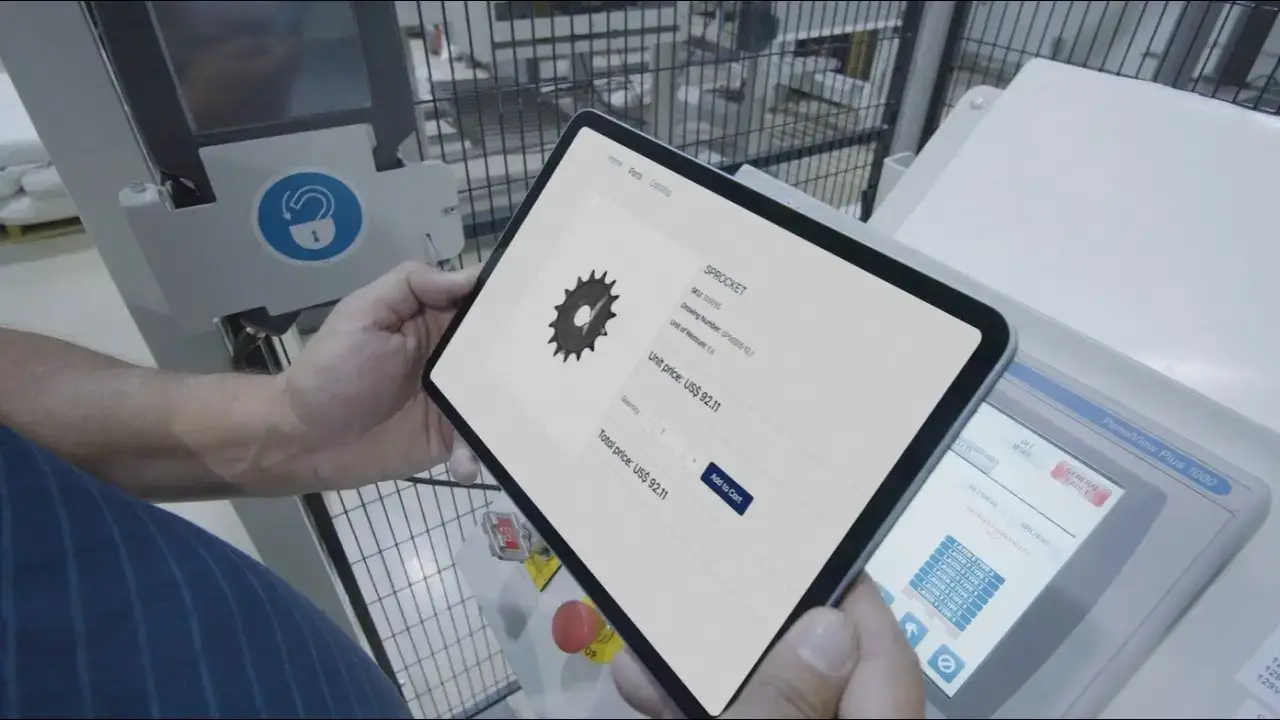
Premier Tech has already made spare parts management easier through its Client Portal, which gives customers a centralized way to access important equipment-related information across one or multiple plants. Designed to be reliable, user-friendly, and fast, the portal helps customers manage equipment by plant and quickly find the information they need to support maintenance and parts planning. 

For each piece of equipment, customers can access a spare parts list organized by category, along with equipment details, cases, robot-related information, and NECTON™ data when available. These lists can also be supported with custom spare parts lists and kits tailored to the equipment and operational needs. 

From there, customers can browse the parts catalogue, review quotes, place orders, and reorder more quickly. If a part is not listed, they can submit a request, and a Premier Tech parts technician will research it, add the missing part to the catalogue within 24 hours, and notify the customer—helping maintenance teams move faster when issues arise. 

The portal also supports a smoother service experience by giving customers one centralized place to request support, access Premier Tech’s free 24/7 technical assistance, request service, view upcoming visits and service history, and track service requests. 

With this digital experience continuing to evolve, the next version of the Client Portal is designed to make spare parts management even simpler, more efficient, and more connected. 

According to Alexis Popko, Premier Tech’s Parts Manager: 

“As customer expectations evolve, digital tools need to make spare parts management simpler, faster, and more connected. That is exactly the direction we are taking with the Client Portal.” 

Digital tools support better planning

Digital tools do more than simplify ordering. They also help support a more proactive approach to spare parts management. Premier Tech can provide suggested spare parts lists, spare parts kits, and customized recommendations based on the equipment and application, helping customers keep key parts on hand and reduce potential downtime. 

Together, digital access and expert support make it easier for manufacturers to manage spare parts with greater speed and confidence.


Conclusion: a smarter approach to uptime, maintenance, and cost control

As downtime costs continue to rise, spare parts management is becoming a more important part of manufacturing performance. The ability to identify, access, and plan for the right replacement parts can make a major difference in reducing disruption, improving maintenance execution, and controlling costs. 

Manufacturers that take a more proactive approach, through better inventory practices, preventive maintenance, and digital support, are in a stronger position to improve reliability and respond faster when issues arise. 

At Premier Tech, this approach extends beyond spare parts supply alone. Through service agreements, preventive maintenance, connected technologies, and digital tools such as the Client Portal, we help customers simplify spare parts management and support more reliable operations over the long term.

Want to make spare parts planning easier and keep your equipment running more reliably?

Reach out to Premier Tech to explore our service agreements, spare parts support, and digital solutions.