

Designing automated packaging lines for the next generation of growing media
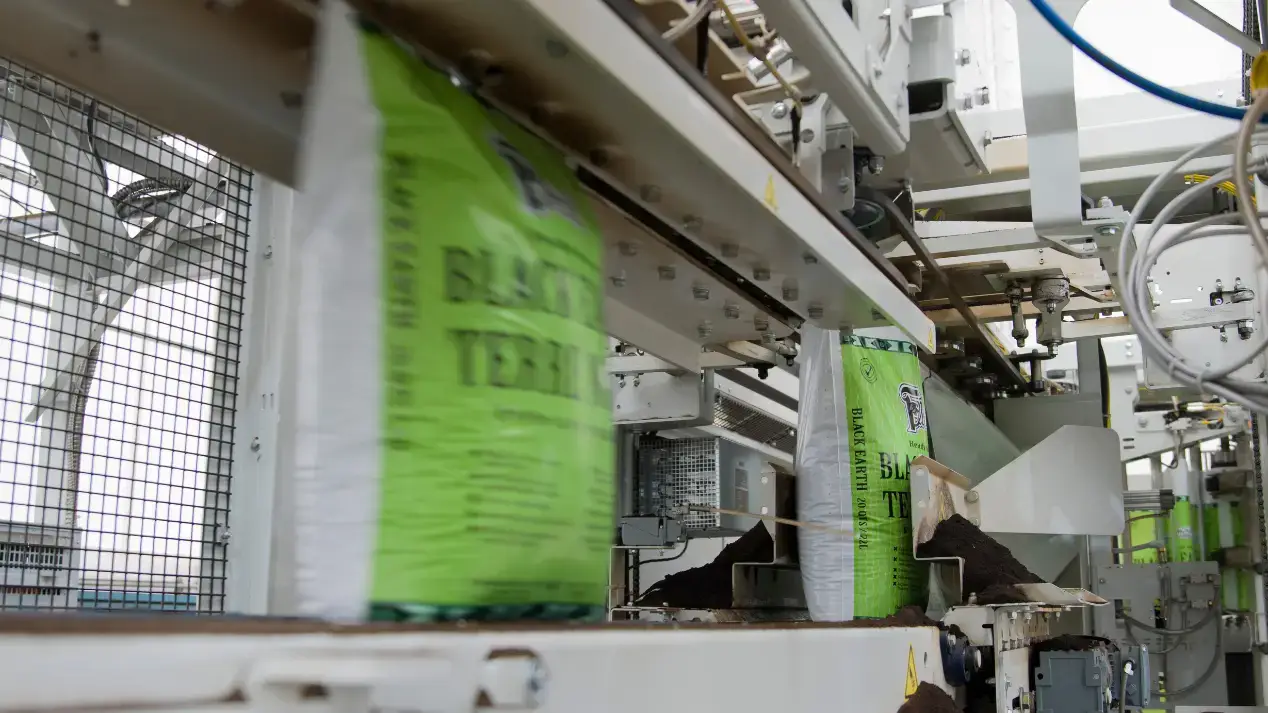
Global demand for growing media is rising fast. Greenhouses and protected cultivation are expanding, growers need to produce more with fewer resources, and new markets are opening up across regions. At the same time, growing media product portfolios are changing: traditional peat‑based mixes are giving way to a broader range of hybrid substrates and more specialized recipes for different crops and applications.
For substrate producers, this shift is not only about what goes into the bag. It also changes how products need to be processed, bagged and palletized. Higher volumes, more SKUs, new formats and different substrate properties all put additional pressure on existing lines. Packaging and palletizing can no longer be treated as a simple end‑of‑line step — they have become a strategic part of the operation.
The growing media market is expanding — fast
More food, more greenhouses, more growing media
Feeding a growing population in a changing climate is one of the defining challenges of our time. According to estimates from the FAO and the United Nations, the world will need to produce around 60% more food by 2050, while using land and water more efficiently and reducing environmental impact. This is accelerating the shift towards more controlled growing systems.
Controlled Environment Agriculture (CEA) is central to this transformation. It covers greenhouses and other covered growing systems where climate, water and growing media can be managed much more precisely than in open fields. Satellite-based analyses indicate that greenhouse-covered land has expanded from about 300 square kilometres four decades ago to more than 13 000 square kilometres today — an area nearly the size of Connecticut — with China now accounting for close to 60% of the world’s greenhouses. Greenhouses and other controlled environments enable growers to produce more food on less land, with greater control over climate, water and inputs.

Greenhouse boom in Weifang, China. Between 1987 (left) and 2024 (right), large areas of open farmland have been converted into greenhouse production, illustrating how protected cultivation is rapidly expanding and driving higher demand for growing media.
Image: NASA Earth Observatory image by Lauren Dauphin, using Landsat data from the U.S. Geological Survey. Story by Adam Voiland.
In North America, greenhouse production is also gaining ground. In Canada, for example, greenhouses already achieve some of the highest yields per unit of land in the world and are expected to double in acreage over the next decade (RBC). By growing fruits and vegetables in enclosed structures and in controlled growing media, Canadian growers can better withstand extreme weather and seasonal shifts, helping secure a consistent supply of fresh produce.
In southeastern Spain, the province of Almería — one of Europe’s driest regions — has become a major hub for greenhouse agriculture. On the coastal plain known as the Campo de Dalías, some of the highest concentrations of greenhouses in the world can be found. Regions like Almería show how protected cultivation can turn challenging conditions into high‑volume, substrate‑intensive production — and why the demand for reliable growing media keeps rising.

Almería’s “sea of greenhouses”, Spain. Thanks to innovations such as drip irrigation, artificial growing media and hydroponics, they produce an estimated 2.5–3.5 million tons of fruits and vegetables per year for markets across Europe.
This global greenhouse boom has a direct consequence: it structurally increases the demand for technically advanced growing media. Some projections suggest that the global growing media market could grow by a factor of three to four between 2017 and 2050, with usage shifting strongly towards Asia (International Society for Horticultural Science). Modern greenhouses, vertical farms and other soilless systems depend on substrates that deliver precise water and air management, support healthy root systems and enable high yields crop after crop.
As more of the world’s food and a significant share of ornamental horticulture are produced in these systems, growers need growing media that are not only agronomically reliable, but also available at scale and aligned with sustainability expectations.
From seasonal business to year-round, high-volume operations
In the past, growing media production was largely shaped by seasonality. Peat extraction, a primary component in many traditional mixes, was restricted to the dry summer months. Production ran in strong peaks, volumes were smaller, and most products were shipped to nearby, often domestic, customers.
Today, the picture is very different. Many producers now operate on an almost year‑round schedule to keep up with demand from professional growers and retail markets. Supply expectations have shifted from “make enough for the season” to “be able to deliver, consistently, 12 months a year.” At the same time, more producers are expanding their export volumes and serving clients in multiple countries and regions.
What used to be a highly seasonal, locally driven business is turning into a continuous, high‑volume industrial operation. This puts completely new expectations on production planning, staffing, maintenance — and of course on processing, bagging and palletizing.
How the growing media market is changing
Hybrid growing media are becoming the norm
At the same time, traditional raw materials such as peat are under increasing pressure. In Europe, climate and biodiversity policies put a stronger focus on protecting and restoring peatlands as critical carbon sinks. Peat harvesting is also highly dependent on weather conditions. In 2025, for example, unusually heavy and prolonged rainfall in key European production regions led to harvest volumes well below normal levels. Events like this highlight how vulnerable the value chain becomes when it relies too heavily on a single raw material.
As a result, many substrate producers and growers are moving towards complementary raw materials. This is not simply a matter of swapping one ingredient for another. Each alternative raw material, whether it is wood fibre, coco, bark or composted materials, has its own physical, chemical and biological characteristics. To deliver consistent, high‑performance blends, these properties must be understood and managed in detail.
This is especially true in high‑tech horticulture. In regions such as Benelux and Germany, and in other intensive production hubs across North America and Asia, many growers focus on high‑value crops in advanced greenhouse systems and, increasingly, other controlled-environment setups. In these environments, even small variations in substrate properties can directly affect yield, uniformity, shelf life or disease pressure. The margin for error is small.
Different players are therefore exploring different paths: some are developing wood‑fibre‑based mixes, others are integrating coco or other renewable components, and many are working with hybrid recipes that combine several of these inputs. What is becoming clear, however, is that there will not be a single universal answer. With the expected growth in demand for growing media, and depending on geography, crop type and raw material availability, hybrid substrates are increasingly becoming the norm. For example, wood fibre is gaining traction as a key component in many hybrid mixes, as we explored in our blog article Shaping the Future of Wood Fiber Production.
For Premier Tech, this shift is already visible on the ground. Some customers still rely primarily on peat‑based mixes, while others are introducing alternative materials or designing completely new hybrid recipes. In every case, one requirement remains non‑negotiable: quality and consistency, from the product itself all the way through to how it is handled, bagged and palletized.

New demands from growers, retailers and logistics are reshaping packaging formats
As product portfolios of substrates diversify, expectations around packaging are changing as well. Professional growers are looking for formats that are easy to handle on site — from big bags and bulk solutions to larger bags that integrate smoothly into automated filling lines. Hobby and smaller professional users expect convenient, clearly labelled bags that are easy to carry, store and use.
Retailers and logistics partners add their own requirements: pallets must be stable, easy to handle and space‑efficient, while packaging needs to protect the product throughout transport and storage. The result is a growing mix of bag sizes, formats and pallet configurations that packaging lines must be able to handle reliably, without slowing down production or compromising quality.

A growing range of substrates and formats – from hobby bags to professional mixes – is reshaping expectations for packaging and palletizing.
Designing future‑proof processing and packaging lines for hybrid growing media
What growth means for screening & mixing, bagging and palletizing
The evolution in production volumes and year‑round supply translates directly into new requirements for both processing and end‑of‑line equipment. More demand means higher throughputs on screening and mixing equipment, more bags to fill, more pallets to build and more trucks to load — often with tighter delivery windows and higher service level expectations.
All of this increases the pressure on manufacturing equipment. Producers are looking to:
- Increase capacity – to handle higher throughputs without sacrificing reliability or line performance.
- Limit costly downtime – by relying on robust, maintainable equipment and well‑designed line layouts.
- Protect product and packaging quality – ensuring precise weights or volumes, preserving substrate structure during filling and compaction, and building stable, transport‑ready pallets.
- Manage inventory more effectively – by producing reliably according to plan, avoiding last‑minute bottlenecks that lead to stock shortages or rushed, sub‑optimal production runs.
As growing media production scales up, upstream processes such as screening and mixing, together with bagging and palletizing, can no longer be viewed in isolation. They form a connected system that has a direct impact on cost, service levels, inventory reliability and customer satisfaction.
Processing different flow, density and compression profiles
Hybrid growing media come with very different physical behaviours. Compared with traditional peat‑based mixes, new recipes can be lighter or heavier, more fibrous, more “springy” or more compact. That can translate into challenges on the production line: material bridging in hoppers, irregular flow to the dosing system, uneven filling and bags that are harder to shape consistently.
Bulk density and compression behaviour can also vary significantly between components. As an example, peat moss is typically compressed at ratios of about 2:1 to 3:1 in commercial bales, because pushing compression much further can damage fibre structure and make rehydration difficult. By contrast, some highly compressed coco and wood fibre products can reach much higher expansion ratios, well above 10:1 in certain formats.
When you run these different mixes through the same bagging line, the nominal bag size may stay the same, but the actual weight and compaction can change from one recipe to another. Without proper control, this can lead to weight drift, inconsistent product presentation and even issues with transport and storage.
To handle this variability, packaging lines need feeding, dosing and weighing systems that are designed for a wider range of flow and density profiles. Parameters of operation must be adjustable by recipe, so that each mix can be filled cleanly, accurately and repeatably, without constant manual intervention. The benefits are clear: fewer rejects, better compliance with customer and regulatory specifications, and a stronger, more reliable brand image in the market.
Building in flexibility for formats, recipes and future changes
As product portfolios evolve, most producers need to handle multiple packaging formats within the same facility: small hobby bags, larger professional bags, big bags (FIBC), and sometimes bulk solutions. In some cases, this even includes stand‑up pouches for smaller volumes, which means bagging equipment has to be adapted to handle these formats alongside more traditional bags.
At the same time, the move towards hybrid growing media means more recipes to manage, with different proportions of peat, wood fibre, coco and other components tailored to specific crops and customer segments.
Wood fibre is a good example of how these new recipes affect the process. Its specific particle size, bulk density and expansion behaviour require adapted processing and screening before it even reaches the mixing and bagging line. We recently documented this in a case study with Mikskaar Miksgrow, using a Slootweg BPE Series Wood fibre machine to stabilize particle size, reduce contaminants and improve downstream line performance – making behaviour on the screening, mixing and packaging line much more predictable.
To stay ahead, packaging and palletizing lines should be designed with flexibility in mind. That can mean:
- Fast, simple changeovers between bag sizes and products
- Machine “recipes” that store optimal settings for each substrate mix and format
- A modular line layout that makes it easier to add new formats, a robot palletizer, stretch hooding or other end‑of‑line equipment later on
For Premier Tech, the key message is simple: design your line today for a market that will keep evolving. Lines built with flexibility and modularity at their core are much better positioned to support new hybrid recipes, new formats and future growth without requiring a complete redesign every few years.

Why the right automation partner matters
Hybrid growing media, rising volumes and more SKUs make packaging and palletizing more complex. Choosing the right automation partner can be the difference between a line that struggles to keep up and a line that supports your growth.
Turning product strategy into a reliable line with Premier Tech
With more than 100 years of expertise in everything substrate, Premier Tech has built a deep understanding of how growing media behave — from raw materials to processing, mixing, packaging and palletizing. Through Premier Tech Systems and Automation, we turn that know‑how into complete lines that help producers manage higher volumes, a broader range of mixes and more SKUs, without compromising on quality or uptime.
The growing media market is getting bigger and more complex. If you are reviewing your recipes, formats or capacity, it may be the right moment to look at how your screening & mixing, bagging and palletizing lines can support your next steps. To see how Premier Tech can help you design and operate these lines, visit our Soil processing and packaging line page.
Ready to upgrade your growing media processing and packaging?
If you are looking for a more efficient way to handle screening, mixing, bagging and palletizing for peat‑based and hybrid growing media, take a closer look at Premier Tech’s soil processing and packaging solutions. Designed for high performance and reliability, our lines help you manage higher volumes, more recipes and more formats with confidence.
