

The Future of Sustainable Protein: How Insect Farming is Transforming the Food Industry
How does insect farming work?
Growing and harvesting
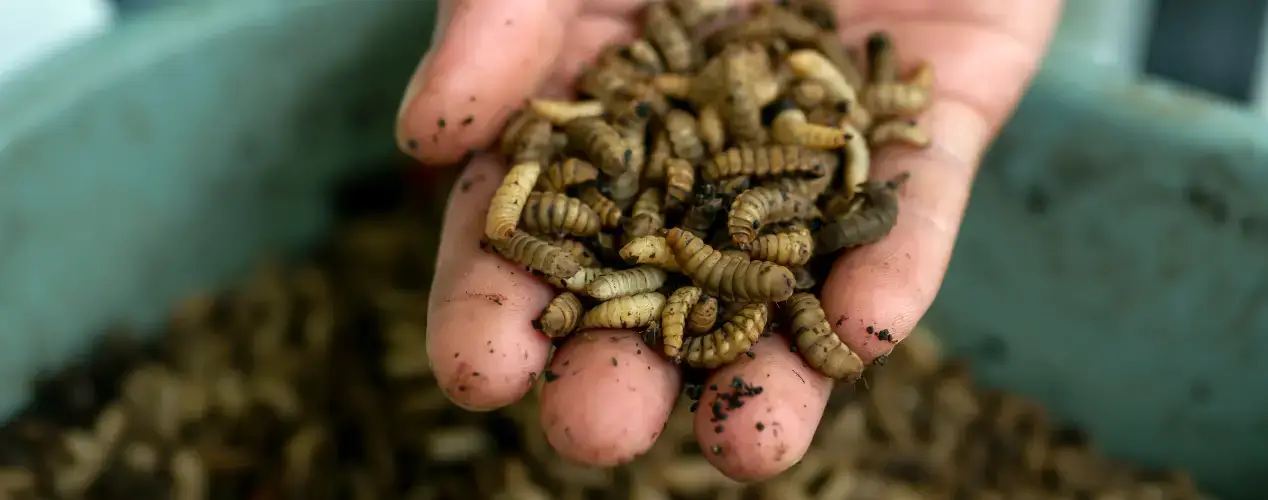
The process of insect farming is relatively straightforward. Traditionally, insects were collected from the wild, but today, most commercial farms use specially designed indoor facilities. After collecting enough live specimens of a chosen species, insects are fed a carefully formulated diet at an optimal temperature to encourage breeding. Once the insects hatch and reach the desired size—larval or adult—they are harvested, usually using automation for efficiency. This process is remarkably fast; for example, black soldier fly larvae typically reach harvest size in just 10 to 14 days.
Inactivation and heat treatment
Some insects contain enzymes that may be harmful to humans or could spoil the product. Farmers must inactivate these enzymes before processing. Usually, insects are cleaned and blanched in boiling water; some may be heated in ovens instead.
Drying and processing
After heat treatment, insects are dried (in ovens, under the sun, or in freezers) to reduce their water content and increase shelf life. Once dried, they are processed according to their intended use: ground into meal, pressed for oil, or sold whole. They can also be fried, pelletized, or incorporated into food products.
Benefits of insect farming
Insect farming offers multiple advantages over conventional livestock farming.
Nutritional value
Insects are an excellent source of complete protein, containing all essential amino acids necessary for human health. Protein content varies from 20% to 76% of dry matter. They are also rich in mono- and polyunsaturated fatty acids, trace elements (copper, iron, magnesium, manganese, phosphorus, selenium, zinc), and vitamins such as riboflavin, pantothenic acid, biotin, and folic acid—depending on the species and developmental stage (Rumpold & Schlüter, 2016).
Efficient farming
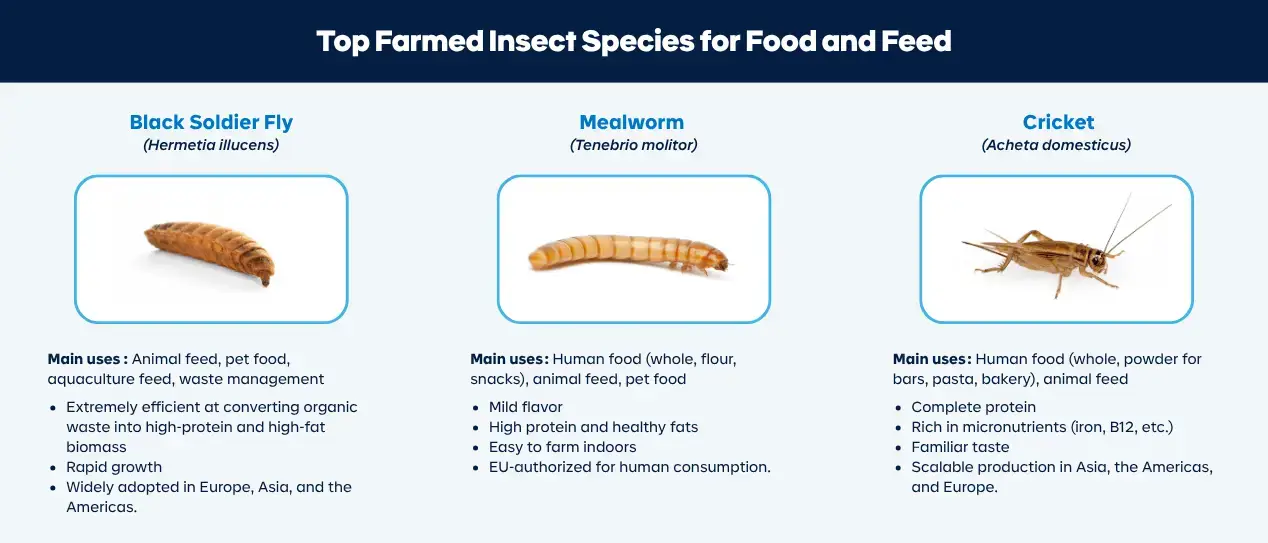
Insects demonstrate higher feed conversion efficiency than mammalian livestock. For example, the feed conversion rate of the house cricket (A. domestica) is twice that of chickens, four times higher than pigs, and over twelve times higher than cattle(Rumpold & Schlüter, 2016).
Environmental Impact
Insect farming is highly versatile and can be conducted almost anywhere, requiring significantly fewer resources and much less space than other forms of animal agriculture.
For example, cricket protein powder production has a much lower carbon footprint compared to traditional livestock, which have a notable environmental impact (Mighty Cricket).
In 2021, Premier Tech collaborated with Québec-based company Entosystem, a producer of high-quality insect protein, to help them build an automated line for the reception and processing of organic waste. Inaugurated in 2023, the 100,000-square-foot site now boasts the largest insect production capacity in North America. At the heart of the factory, our systems enable efficient handling of organic materials, such as unsold fruits and vegetables from grocery stores. This waste is then ground and mixed with dry ingredients, like distillers' grains—a cereal byproduct from the distillation process. The resulting paste, an ideal food source for black soldier fly larvae, is distributed into containers managed by our custom RPL-9000 SERIES robotic palletizing system. Thousands of tiny larvae are then automatically introduced into these containers, ready to feed on the organic waste.
Once well fed, these larvae are dried and ground into rich protein used as feed for domestic and farm animals. What remains of the processed food residues, known as frass, is sold as fertilizer. Entosystem’s installation has the capacity to process 250 tons of organic waste per day, all consumed by black soldier fly larvae. In the future, the company aims to divert 40,000 tons of organic materials annually and produce 5 tons of insect flour and 7 tons of organic fertilizer each day.
This integration of innovative technology demonstrates the potential of insect farming at scale—not only for sustainable protein production, but also for effective waste management and the creation of valuable byproducts.

Producing one pound of beef requires about 1,800 gallons of water, while one pound of cricket protein needs only one gallon. Choosing farmed insects over traditional livestock can help conserve water and make food production more sustainable.
Challenges
While insect consumption offers many benefits, several challenges could limit its growth.
Dietary Changes
According to the World Health Organization, diet evolves over time, influenced by many social and economic factors that interact in a complex manner to shape individual dietary patterns. Globalization and the influence of Western diets may lead populations that currently consume insects to shift away from this practice.
Price
Food prices greatly influence consumer choices. In Europe and North America, insect-based foods remain expensive due to limited demand and the small scale of the industry, unlike the large, subsidized meat industries.
Western Attitudes
Insect eating is not a tradition in Western countries, and there remains a negative perception of insects as food. To overcome this, more research and communication about the nutritional value of various insect species are needed. A clear legal framework is also essential to ensure consumer confidence in product safety and sourcing.
Insects: The food of the future?
Despite growing interest and the rapid expansion of the industry, consumer acceptance remains a major barrier in many countries. As a result, the share of farmed insects directly consumed by humans is currently negligible. The vast majority are instead processed as premium pet food or used as feed for farmed animals.
However, insect farming is already a significant industry. Every year, over a trillion insects are farmed for various purposes—including animal feed, pet food, human consumption, clothing, and traditional medicines (Sentient Media, 2024). Furthermore, the market is projected to grow rapidly; the edible insects market was valued at USD 0.874 billion in 2023 and is projected to reach USD 3.0481 billion by 2031, growing at a CAGR of 16.90% from 2024 to 2031 (Verified Market Research). Some key companies in the edible insects market include FarmInsect GmbH, LIVIN farms AgriFood GmbH, BETA BUGS, and others.
Insects as Feed: The Key?
While human consumption is expected to grow slowly as consumer perceptions evolve, the use of insects as feed for farm animals—such as chickens, pigs, and especially for aquaculture—is expanding much more rapidly. According to Reuters, insect feed is gaining traction in agriculture and aquaculture as a sustainable alternative, especially as feed grain prices rise and companies aim to reduce their carbon footprint.

Using insects as aquaculture feed could be crucial for feeding a growing world population. According to the FAO, aquaculture is the fastest-growing food production sector and is vital for global food security. However, traditional protein sources are no longer adequate for this expansion, as wild fish stocks are fully exploited and fishmeal production has plateaued.
The pet food sector is also adopting insects. In 2024, the FDA approved Ÿnsect as the first company authorized to commercialize mealworm proteins for dog food in the United States. The first long-term study (six months) on dogs demonstrated that defatted mealworm flour offers high-quality protein, unsaturated fatty acids, fiber, vitamins, and minerals. As a substitute for traditional animal proteins, mealworm protein can help significantly reduce the environmental footprint of pet food.
